
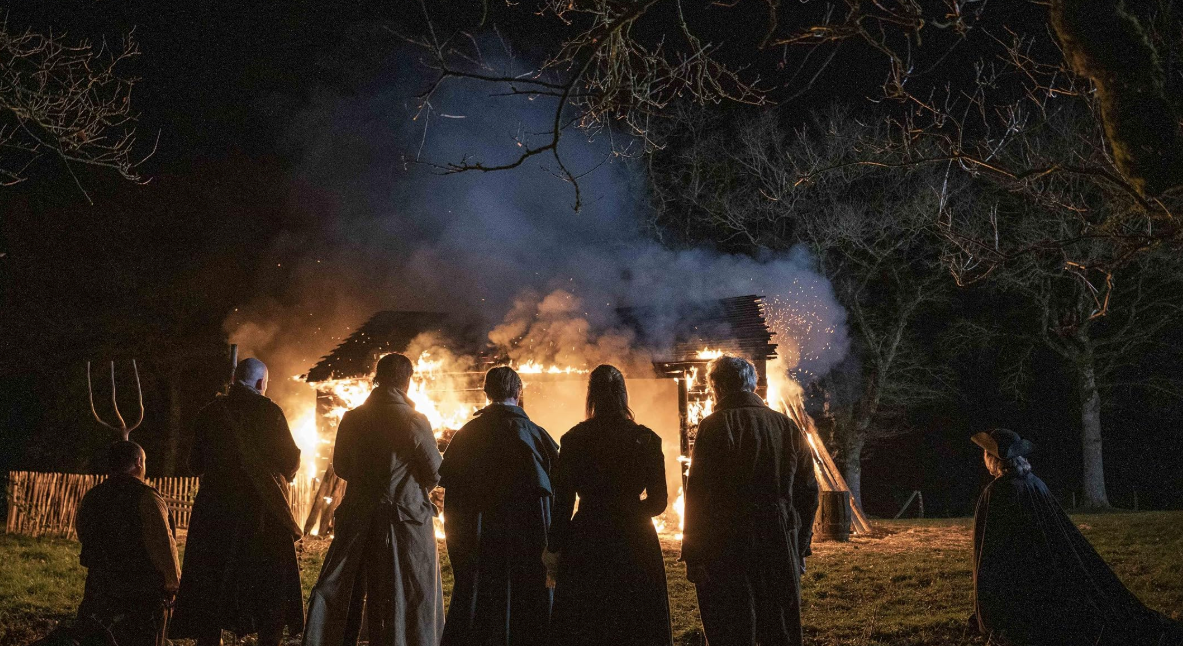
Following the persecution of the Catholic Church, the execution of King Louis XVI, and the introduction of mass conscription, Catholic royalist peasants in the Vendée region of western France rose up against the republican regime in 1793. Initially, the rebellion was successful. Eventually, however, the government crushed it through scorched-earth tactics, leaving more than 200,000 people dead—perhaps as many as one-third of the region’s population. Because this episode captures both the Revolution’s brutality and a counter-revolution led by ordinary people, it has remained central to the French right’s historical identity. Outside France, however, it is still largely unknown.
Victory or Death, a 2023 French film newly released in the United States, seeks to change that. It follows the career of General François-Athanase Charette de La Contrie (played by Hugo Becker, familiar to some American audiences from Gossip Girl). A veteran of the American War of Independence, Charette is called out of retirement in 1793 to defend the Vendéens against the Republic’s bayonets. The film traces his campaign until his forces are overwhelmed by the revolutionary armies and he is ultimately executed. It is a story of heroism culminating in martyrdom. Like Joan of Arc, Charette is denied the sacraments by his captors.

Victory or Death is a vivid and gripping historical drama, but it also serves a serious purpose. Produced by figures associated with the French right and the historical theme park Puy du Fou, it aims to raise awareness of an episode of repression that Alexandr Solzhenitsyn regarded as a rehearsal for the left-wing totalitarianism of the twentieth century. Battles over historical memory—whether surrounding the French Revolution, the Spanish Civil War, or the Russian Revolution—are becoming increasingly important. Younger factions of the contemporary left increasingly interpret their political struggles through the lens of Europe’s historical conflicts. They see rising fascism as one of the defining threats of our time. They believe America is already controlled by fascists—and they draw the logical conclusions from that belief.
Victory or Death offers a right-wing alternative to this interpretation of history, appealing to the same audience that visits Puy du Fou. Founded by the Catholic entrepreneur, writer, and politician Philippe de Villiers, Puy du Fou uses the theme park format to tell the story of France through a series of large-scale historical performances built around elaborate sets. The park features several reconstructed medieval villages and castles, one of the world’s largest falconries, and a replica Roman amphitheater seating 7,000 spectators. Its performances are technically impressive choreographed spectacles combining acrobatics, live animal displays, large-scale battles, and dance, all centered on heroic and romantic protagonists.
Puy du Fou’s productions are about as historically accurate as Buffalo Bill’s Wild West show. Its gladiatorial games blend the visual style of Ben-Hur’s famous chariot race with Ridley Scott’s Gladiator (the amphitheater itself opened shortly after the release of the second film). In another production, English armies besieging a French castle are defeated through unmistakable acts of divine intervention.
Now more than forty years old, Puy du Fou has become both a commercial and cultural success. It thrives on regional patriotism, mobilizing an army of young volunteers who spend their summers helping operate the park. A three-day family visit to Puy du Fou is also considerably more affordable than a comparable trip to Disneyland. Since its opening, the park has expanded steadily and received numerous international awards recognizing the quality of its productions. Despite its distance from Paris, Puy du Fou now attracts around two million visitors each year, making it the third-largest theme park in France. Through it, de Villiers has shared his vision of French history with millions of visitors.
Every center-right French president since Valéry Giscard d’Estaing—including Emmanuel Macron—has visited Puy du Fou as a gesture of goodwill toward the conservative electorate; Macron even exempted the park from certain Covid restrictions. Yet despite its remarkable cultural success, Puy du Fou has never succeeded in translating that influence into lasting political power. De Villiers ran for president twice without success. When Éric Zemmour launched his unsuccessful presidential campaign in 2022, with de Villiers’s endorsement, he even adopted the music from the park’s falconry show as his campaign theme.