
The rapid rise of populist movements across advanced democracies is closely linked to changes in labor market performance. While cultural concerns, identity politics, and social media have all contributed to populist success, growing evidence suggests that economic insecurity—driven by globalization, automation, and the aftermath of the 2008 financial crisis—has been the principal catalyst.
Over the past several decades, globalization and technological change have fundamentally reshaped labor markets. Automation has hollowed out middle-skilled occupations, while international trade has displaced workers in manufacturing and other industries exposed to foreign competition. Although these transformations have generated substantial gains in productivity and overall economic growth, their benefits have been distributed unevenly. Highly skilled workers and globally competitive industries have prospered, whereas many middle-income communities have experienced job losses, wage stagnation, and declining economic prospects.
These disruptions created fertile ground for populist politics. Communities affected by factory closures, outsourcing, and technological displacement became increasingly distrustful of political and economic elites, whom they viewed as benefiting from globalization while ignoring its social costs. As traditional parties struggled to address these grievances, anti-establishment movements successfully framed themselves as defenders of “ordinary people” against distant political and corporate elites.
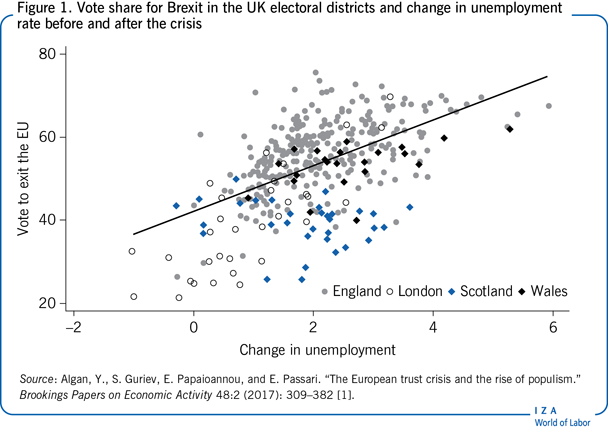
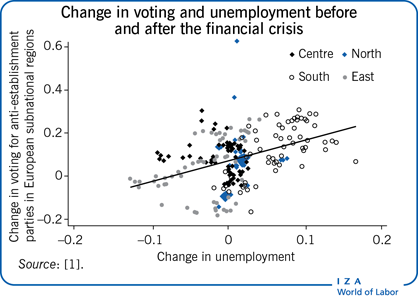
The global financial crisis further intensified these dynamics. In Europe especially, prolonged unemployment and slow economic recovery severely damaged confidence in mainstream institutions. Empirical research consistently finds that regions experiencing larger increases in unemployment also recorded significantly stronger support for populist parties. Importantly, the effects extended beyond those who actually lost their jobs. Rising regional unemployment also heightened insecurity among employed workers, who feared declining career opportunities and weaker bargaining power.
Research also demonstrates a strong relationship between exposure to globalization and support for populist candidates. Studies of the “China shock” in the United States show that regions most exposed to Chinese import competition experienced larger shifts toward Donald Trump in 2016. Comparable evidence exists across Europe, where regions more vulnerable to import competition and industrial automation have recorded stronger electoral support for radical-right parties.
Despite successfully channeling economic frustration into electoral gains, populist governments have generally struggled to deliver superior economic outcomes. Evidence from countries such as Hungary, the United Kingdom after Brexit, and the United States under Donald Trump provides little indication that populist policies produce stronger growth or better labor market performance than those of mainstream governments. In some cases, populist administrations have weakened institutional checks and balances, increased political uncertainty, and undermined long-term investment without resolving the structural causes of economic insecurity.
This does not imply that the grievances fueling populism are unfounded. On the contrary, the evidence suggests that many voters respond rationally to declining employment opportunities, regional economic decline, and the perception that political elites have failed to protect those adversely affected by globalization and technological change. The challenge lies not in dismissing these concerns but in addressing them through effective public policy.
Rather than relying on protectionism or anti-establishment rhetoric, governments should strengthen social safety nets, expand active labor market policies, invest in lifelong learning and worker retraining, and implement regional development strategies for communities disproportionately affected by structural economic change. During recessions, stronger countercyclical fiscal policy can also help stabilize employment and reduce the economic shocks that often fuel political radicalization. Finally, restoring public trust requires ensuring that the benefits of economic growth are shared more broadly, including through more effective taxation and efforts to combat tax avoidance.
The rise of populism reflects not simply a cultural revolt but a prolonged failure to manage the social consequences of globalization, technological transformation, and economic crises. Unless advanced democracies succeed in delivering more inclusive and resilient labor markets, the political conditions that have fueled populist movements are likely to persist.