
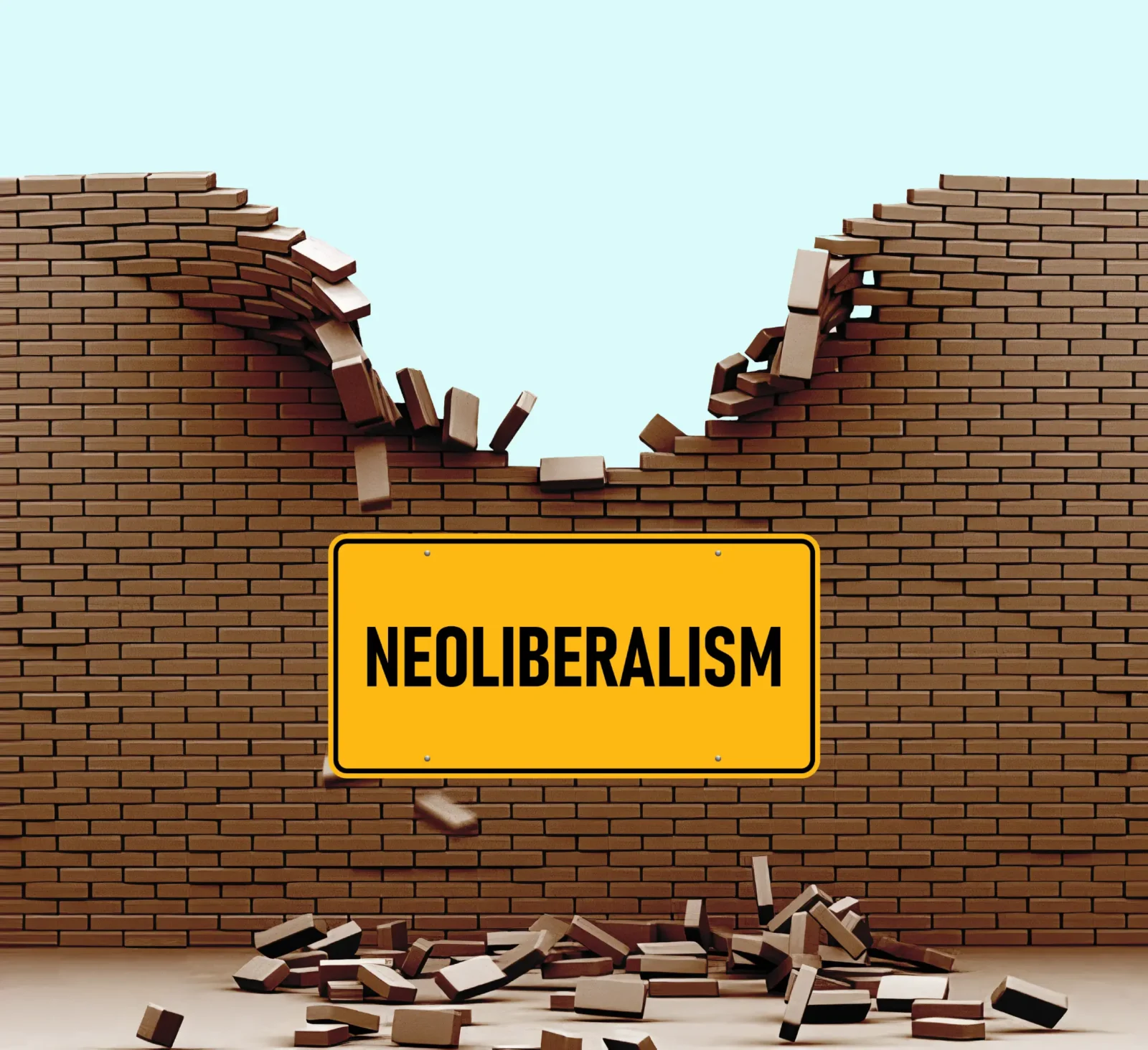
Whether neoliberalism is truly exiting the stage of history is a question that resurfaces with every major economic or political upheaval, yet it remains far from settled. Indeed, confident pronouncements of neoliberalism’s imminent demise have accompanied virtually its entire historical trajectory, even at moments when such predictions seemed least plausible—for example, Eric Hobsbawm’s assertion in 1998 that “the neoliberal balloon is visibly deflating.” Since the global financial crisis of 2008, such assessments have become more numerous and more emphatic, drawing on developments including the Great Recession, Brexit, Donald Trump’s first presidency, the Covid-19 pandemic, the geo-economic challenge posed by China’s rise, “Bidenomics,” climate disruption, the war in Ukraine, and, most recently, Trump’s return to office, together with the trade conflicts and military confrontations that have accompanied it.
Among the more notable contributions—focused primarily on the American case—David Kotz has argued in these pages that the neoliberal regime of accumulation has been trapped in a structural crisis of stagnation since the 2008 financial crash, from which only the construction of a new institutional regime can provide a genuine break. Gary Gerstle, in The Rise and Fall of the Neoliberal Order, portrays neoliberalism as a political order—a constellation of ideologies, policies, and constituencies—that gradually fractured along the turbulent path from the financial crisis to the pandemic and the Capitol riot of January 6, 2021. More recently, examining the causes and likely consequences of Trump’s trade wars, Lee Jones has written of the neoliberal order’s “accelerating decay,” reflected in the hollowing out of America’s manufacturing base, the erosion of state capacity, and the gradual weakening of U.S. global hegemony.
On the other side of the debate, many scholars have emphasized continuity and adaptation rather than decline. In the immediate aftermath of the 2008 financial crisis, Colin Crouch and Philip Mirowski each published influential books highlighting neoliberalism’s remarkable ability to reinvent itself by presenting its own principles as the solution to the economic failures and financial instability produced by their implementation. In a recent essay, Perry Anderson similarly observed that “the contemporary opponents of neoliberalism are still for the most part whistling in the dark,” since “little has changed in the underlying drivers and contradictions of the system it has created.” Alongside these arguments, an increasingly extensive vocabulary has emerged to describe neoliberalism’s post-2008 evolution: Jamie Peck’s “zombie neoliberalism,” Ian Bruff’s “authoritarian neoliberalism,” William Davies’s “punitive neoliberalism,” William Callison and Zachary Manfredi’s “mutant neoliberalism,” and Trissia Wijaya and Kanishka Jayasuriya’s “militarized neoliberalism.”
How, then, should we understand the present condition of what has been called “the most successful political ideology in world history”? The argument advanced here is that the pattern of accumulation established during neoliberalism’s ascendancy in the late twentieth century—financialized, globalized, and driven by elite interests—remains firmly intact and may be considerably more resilient than many of its critics assume. At the same time, however, neoliberalism as a coherent policy doctrine has effectively unraveled across the West. Its defining economic prescriptions and intellectual commitments have either been abandoned outright or preserved only in hybrid forms that combine them with their apparent opposites, producing policy agendas and political discourses that are no longer recognizably neoliberal—though neither are they Keynesian, laissez-faire, dirigiste, or easily captured by any familiar category in the historical vocabulary of political economy.
This process of doctrinal disintegration has emerged because Western governing elites, confronted with a succession of destabilizing crises stretching from 2008 to the present, have systematically discarded neoliberal principles and violated neoliberal norms whenever doing so appeared necessary to preserve the existing pattern of capitalist accumulation. The resulting loss of intellectual coherence has posed little difficulty for dominant corporate and class interests. Scholars may find the absence of a consistent governing paradigm intellectually unsatisfying; capital accumulators are generally less concerned.
Any attempt to assess neoliberalism’s contemporary condition must first confront the concept’s notoriously contested definitional boundaries. A rich body of scholarship in intellectual history has traced the origins of neoliberal thought to early twentieth-century Germany and Austria, following its successive reformulations and transnational diffusion through to the Reagan and Thatcher revolutions of the 1980s. This is not the place to revisit the specific ideological components identified in that literature. It is enough to note that they are numerous and span multiple domains: political philosophy, with its conception of human freedom grounded in market liberty; constitutional design, particularly the insulation of central banking from democratic politics; administrative theory, emphasizing the regulation of markets to guarantee neutral competition and a level playing field; public policy, including privatization and trade liberalization; class politics, reflected in anti-union measures and welfare retrenchment; macroeconomic developments such as financialization and globalization; and the micro-social formation of entrepreneurial and consumerist subjectivities.
One of the most significant insights emerging from this literature is that, unlike classical liberalism—and contrary to popular perception—neoliberalism has generally sought not to diminish the state but to repurpose it as an effective guarantor of market order. Consequently, neoliberal governance has produced less deregulation than a far-reaching process of reregulation, reshaping economic life according to neoliberal principles rather than withdrawing the state from it.
The various attributes constituting neoliberalism are perhaps best understood through Wittgenstein’s concept of “family resemblance.” No single characteristic, taken in isolation, is sufficient to establish the presence of neoliberalism. Yet the coexistence of a sufficiently large number of these characteristics within a particular social formation makes its identification plausible. Unsurprisingly, neoliberalism’s historical manifestations have varied considerably across countries and over time. Nevertheless, the logic of family resemblance also implies that below a certain threshold, isolated remnants of neoliberal practice should not be mistaken for neoliberalism itself. Neoliberalism may indeed be “mutant” by nature, and it is worth remembering that “mutants are new life forms seeking to survive a changing environment.” Yet to extend the metaphor, species eventually change as mutations accumulate.
It should also be emphasized that neoliberalism is by no means synonymous with capitalism. The two operate at fundamentally different temporal, spatial, and ontological scales. Capitalism is a mode of production spanning centuries and encompassing the globe; neoliberalism is, at most, a historically specific phase within that broader mode of production, lasting only a few decades and characterizing only certain parts of the world.
Having established this conceptual framework, the remainder of this essay distinguishes three core dimensions in order to assess what remains alive—and what has passed away—within contemporary Western neoliberalism. These are, first, political discourse and ideology; second, economic policy and state intervention; and third, the macro-institutional arrangements that continue to shape the broader patterns of capitalist accumulation.